<aside>
Notable Features: Useful in discovery phase of research
</aside>
<aside>
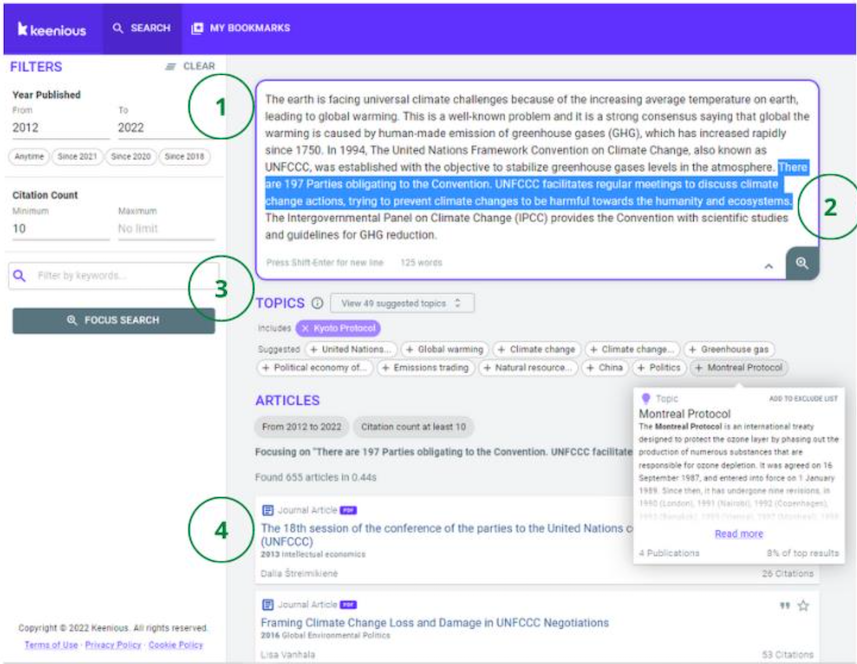
Core Abilities: Text Analysis Engine: Utilizes an AI-based model to perform contextual analysis of user-provided text to determine research intent. Database Integration: Interfaces with the OpenAlex academic database for sourcing scholarly articles. Search Functionality: Employs AI-driven search to recommend articles based on contextual analysis, supplementing traditional keyword-based search methods. In-document Citation: Allows for direct insertion of citations from discovered literature into the active document. Smart Bookmarks: A feature enabling users to save, store, and organize selected articles discovered through the system for future reference.
</aside>
<aside>
Limitations/ Risks: Not for exhaustive review (meant to augment a more comprehensive search. More of a ‘discovery’ engine than a ‘search’ engine. The AI's primary judgment of an article's relevance for ranking purposes is based solely on its title and abstract, not the full text. This means that if key concepts or the true depth of an article are not well-represented in its abstract, Keenious might overlook its relevance or misjudge its conceptual alignment with the user's input.
</aside>
<aside>
Platform/ Integrations: Web app, but also integrates into MS Word and Google Docs. Exports RIS and BibTex (but can only export up to 100 articles at a time)
</aside>
<aside>
Pricing: Free: top 10 results, analyze up to 2 pages, smart bookmarks; Plus: $10/month: top 1000 results, analyze up to 50 pages, advanced filtering, smart bookmarks, bulk export of results (30% discount for students)
</aside>
Tutorials/ Reviews
How to use Keenious | Keenious Help Center
Keenious AI for Literature Review